If you run a hotel, manage a residential society, or operate a factory canteen, you've probably heard the term "Bulk Waste Generator" (BWG) thrown around in the context of India's Solid Waste Management Rules. But what does it actually mean for you, and what do you need to do about it? This guide breaks it down plainly.
Quick answer: Under the Solid Waste Management Rules, 2026, a listed institutional, commercial or residential-society entity is a Bulk Waste Generator if it meets at least one of these criteria: building floor area of 20,000 sq.m. or above, water consumption of 40,000 litres per day, or solid waste generation of 100 kg per day. New BWGs must provide adequate decentralised wet-waste processing; existing BWGs that cannot do so have an exemption and Extended Bulk Waste Generator Responsibility certificate route through the local body.
What Counts as a Bulk Waste Generator?
The 2026 Rules list institutional users, commercial users and residential societies as BWG categories. Examples include government and private-company buildings, schools and universities, industrial units, malls, hotels, hospitals, hostels, markets, stadiums, community or convention halls, marriage or banquet halls, and residential societies.
National BWG Criteria Under the 2026 Rules
An entity in the listed categories is covered as a Bulk Waste Generator if it satisfies at least one of the following national criteria:
| Criterion | Threshold |
|---|---|
| Building floor area | 20,000 sq.m. or above |
| Water consumption | 40,000 litres per day |
| Solid waste generation | 100 kg per day |
Local bodies remain responsible for implementation, registration, service arrangements, certificates and bye-laws, so a property should also check the current directions of its concerned municipal or local authority. Read the official Solid Waste Management Rules, 2026 (S.O. 388(E)).

Already a BWG?
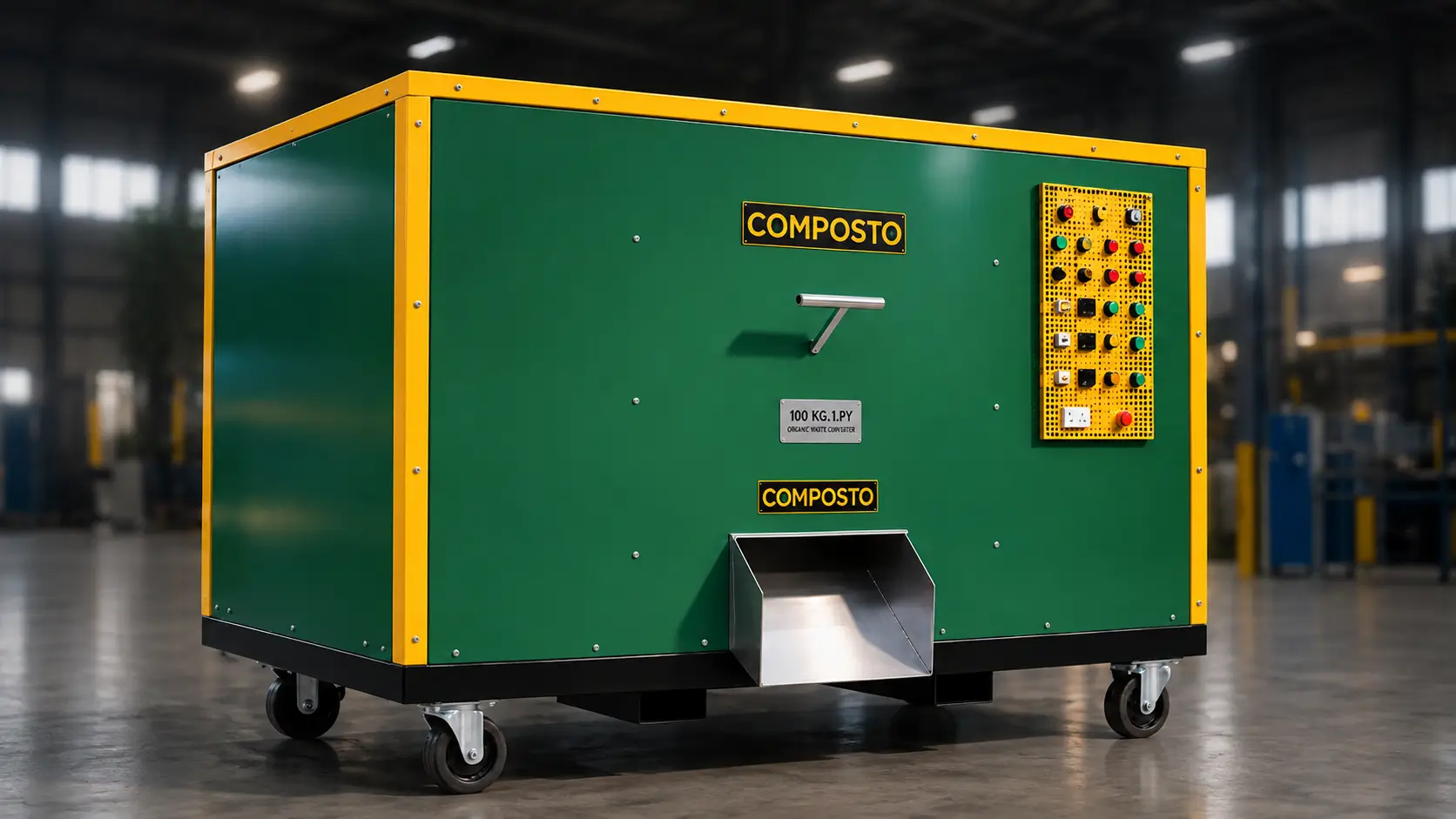
Plan On-Site Wet-Waste Processing With COMPOSTO
COMPOSTO Organic Waste Converters are available from 10 kg to 1000 kg/day. Final capacity should be selected from measured segregated wet-waste load, peak pattern and site conditions.
 Ask on WhatsApp
What Happens If You Don't Comply?
The 2026 Rules provide for environmental compensation in case of non-compliance with the Extended Bulk Waste Generator Responsibility framework. They also require local bodies to notify suitable fine provisions in their bye-laws. The amount and enforcement process can therefore depend on the applicable local authority and the nature of the non-compliance.
How an On-Site OWC Machine Fits Into the Compliance Plan
An Organic Waste Converter can be one part of the decentralised wet-waste processing arrangement required for a BWG. COMPOSTO machines run an enclosed automated processing cycle of about 24 hours; the discharged organic material then requires curing before final compost use. The equipment itself does not replace the other duties placed on the waste generator.
What You Still Need Beyond the Machine
Under the 2026 Rules, BWG responsibilities include more than equipment procurement:
- Registration — BWGs are required to register with the concerned local body through the centralised online portal.
- Separate waste-stream arrangements — dry waste, sanitary waste and special-care waste must be collected and handed over through the prescribed authorised route.
- Complete wet-waste processing — new BWGs must set up adequate decentralised processing for the wet waste they generate; an existing BWG unable to do so must follow the exemption and certificate mechanism provided in the Rules.
- Annual returns — BWGs are required to file annual returns by 30 June through the prescribed portal process.
For a closer look at how this plays out in your specific city, browse our city-specific waste management guides, which cover local rules, enforcement patterns, and real case examples from Delhi NCR to Punjab to Assam.
Choosing the Right Capacity
Sizing should start with a representative measured weight of source-segregated wet waste, not room count, flat count or headcount assumptions. COMPOSTO’s current range includes the VEER 10, 15, 20, 25, 35 and 50 kg/day store series alongside separate commercial OWC platforms from 25 to 1000 kg/day. The first shortlist should cover the measured daily load, followed by checks for recurring peak days, power, access and curing space.
See our full model range and price list for exact specifications, or chat with our team for a sizing recommendation based on your actual waste volumes.
Key Takeaways
Do not classify a property as a BWG from its name or headcount alone. Check the three national criteria in the 2026 Rules, confirm the applicable local-body requirements, measure the actual wet-waste stream and then design the processing system. An OWC can be an important part of that system, but compliance depends on the complete waste-management arrangement.