
RWAs & group housing
A central machine works only if household wet waste arrives segregated through a dependable housekeeping route.
Dense-site OWC guide · Delhi
Delhi properties often have a different constraint from newer planned cities: the machine may be easy to specify but harder to place and feed inside a dense site. For RWAs, institutions, hotels and commercial kitchens, internal waste movement deserves as much attention as daily capacity.
Delhi planning tool
Choose where waste starts, confirm the internal movement condition and use measured kilograms to shortlist the machine.
Keep the biodegradable stream identifiable from source to loading point at the Delhi site.
Delhi buyer fit
Delhi buyers should start with the organic stream they actually generate and the way that stream moves through the property.
A central machine works only if household wet waste arrives segregated through a dependable housekeeping route.
Food preparation and event peaks need separate measurement so the system is not sized from room count or seating capacity.
Only suitable kitchen organics belong in the OWC; biomedical, sanitary and controlled waste stay on their regulated routes.
Canteens, functions and daily occupancy create different load windows that should be mapped before purchase.
Delhi operating reality
Delhi has its own operating details to resolve before a quotation becomes an installation plan.
Narrow service lanes, basements, older utility rooms and shared access can matter more than the footprint printed on a brochure. Measure the path from delivery gate to installation point.
A machine at ground level cannot recover an organic stream that was mixed in kitchens, pantries or household bins. The operating plan should begin upstream.
Delhi clubs and banquet-led properties may have quiet days and concentrated functions. A buyer should know whether recurring peaks will be processed immediately or managed through an operating schedule.
COMPOSTO range for Delhi
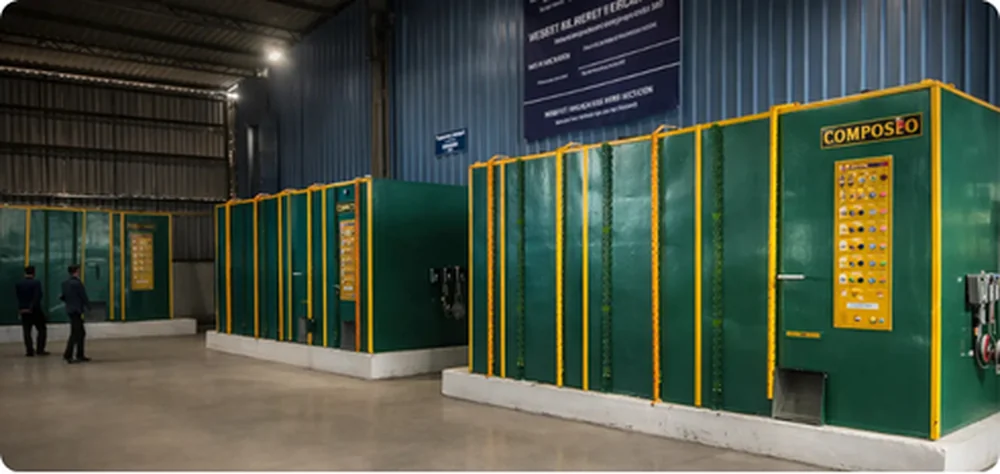
Use measured organic waste from Delhi to shortlist a capacity, then open its product page for dimensions, connected load, construction and controls.
Delhi waste-management context
For Delhi, the machine is one processing component; segregation, operator responsibility and the routes for other waste streams remain equally important.
Read the national 2026 framework alongside current Delhi directions. For Delhi, let the rule define responsibilities while measured organic-waste data determines the equipment shortlist.
Delhi establishments that qualify as Bulk Waste Generators should review current MCD directions together with the Solid Waste Management Rules, 2026. The durable principles are source segregation, responsible processing of wet waste and proper handling of the remaining streams.
Delhi site planning
For Delhi, delivery access, utility-space conditions and the operating routine should be clear before the final installation plan is locked.
For a Delhi site, send the locality, property type, measured organic load and a simple description or photo of the route from unloading point to proposed installation area. This can prevent a technically suitable machine from becoming a difficult physical installation.
Access. Buyers often focus on capacity first and discover late that doors, ramps, basements or shared service lanes make the proposed location difficult.
Yes, provided each block keeps wet waste segregated and housekeeping can move it to the central utility zone without mixing it with dry waste.
Measure routine kitchen waste separately from recurring function peaks. The frequency of those peaks matters more than a one-off maximum event.
No. Compliance depends on the full system: segregation, suitable processing, handling of rejects and other waste streams, operation and applicable records.
Yes. Use Organic Waste Converter Price for published price guidance and All Models for the complete product range.
Delhi quotation checklist
For Delhi, share the facility type, measured daily organic-waste quantity and the site conditions that affect installation. Those Delhi inputs are enough to identify the COMPOSTO capacity worth reviewing first.


