
Electricity Units
Average kW × equivalent hours/day × operating days. This gives estimated monthly kilowatt-hours (kWh), not a machine guarantee.
COMPOSTO by DSC Engineering · Planning Tool
Estimate what an organic waste converter could cost to operate at your site. Calculate electricity units and monthly expense separately from labour, additives and maintenance. All figures are adjustable planning assumptions—not published energy ratings or a quotation.
10–1,000 kg/day nominal capacity range · India-focused ₹ estimates · No fixed savings claims
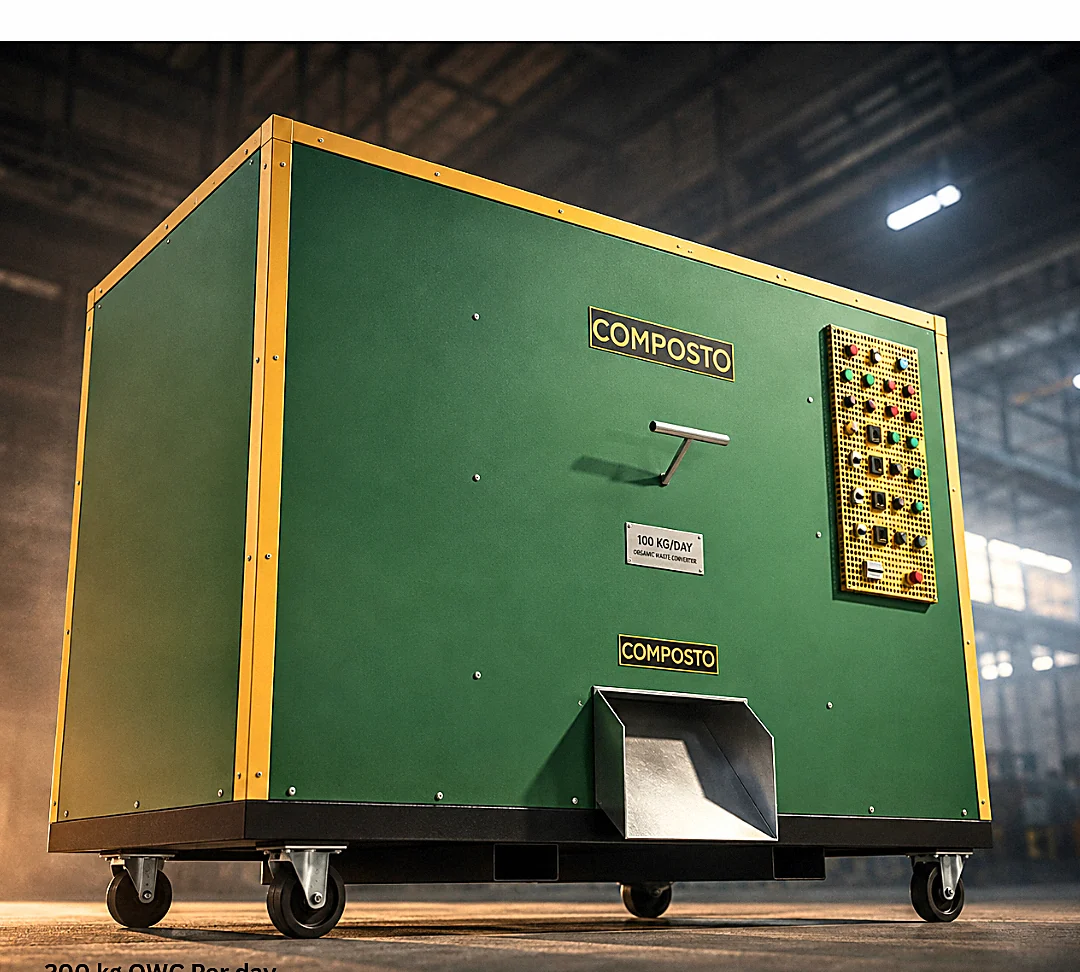
Interactive cost estimator
Enter measured or supplier-confirmed values wherever possible. Connected load (kW) is not the same as actual average consumption (kW); heating duty-cycle, ambient temperature, waste moisture and processing schedule affect actual kWh.
Understand the result
Average kW × equivalent hours/day × operating days. This gives estimated monthly kilowatt-hours (kWh), not a machine guarantee.
Estimated kWh × ₹/unit + optional incremental fixed charges. Local tariff, demand charges and billing rules vary.
(Electricity + incremental labour + consumables + maintenance + other costs) ÷ monthly kg. Higher utilisation spreads fixed costs over more waste.
An 18–24 hour processing cycle does not mean heaters and motors consume full connected-load power continuously. Use actual interval meter readings for meaningful comparisons.
Compare with confidence
Heater on/off time, moisture content and insulation can materially change consumption.
Excess water, non-biodegradables, plastics and fibrous contaminants change processing and maintenance needs.
Nominal 100 kg/day capacity does not mean a site always processes 100 kg every day.
Waste collection, sorting, loading, removal and curing are facility activities that may require labour.
Tariff slabs and fixed/demand charges depend on the customer's connection and utility.
Replacement heaters, shredder blades, bearings and scheduled preventive maintenance affect total cost.
Choose equipment by actual waste load
Capacity should be selected from measured daily segregated waste, waste characteristics, installed electrical capacity and actual operating schedule—not the lowest calculator result alone.
Buyer questions
Actual usage depends on the model, heating duty cycle, waste moisture, insulation and operating practice. Multiply measured average kW by equivalent daily hours and operating days for a planning estimate; request model-specific readings from DSC Engineering.
Not necessarily. Five kW running continuously for one hour would consume 5 kWh, but connected load is not proof of continuous average consumption. Motors and heaters can cycle on and off.
No. This calculator is an operating-cost tool. Purchase price, installation, infrastructure, freight, taxes, depreciation and finance are outside the calculation.
No. Total cost per kg depends on utilisation, power, labour, maintenance and waste characteristics. Oversized equipment can increase underutilised fixed costs.
Use it for early feasibility only. Tender and contractual estimates need verified model-specific electrical measurements, duty cycle, site utility tariff and commercial terms.
Not necessarily. Depending on the technology and feedstock, processed material may require additional curing and quality checks before use as mature compost.
Get a realistic commercial estimate
Share daily measured wet-waste quantity, operation days, electricity tariff, facility type and model preference. Our team can discuss a suitable COMPOSTO configuration and quotation.